Stafford Act Section 312 and Duplication of Benefits
Federal disaster grants and property insurance pay for the same buildings, and federal law does not allow both. How the offset works, where applicants lose money, and what a defensible reconciliation looks like.
The rule
Section 312 of the Robert T. Stafford Disaster Relief and Emergency Assistance Act prohibits any person, business, or government from receiving federal disaster assistance for a loss that is covered by insurance or by another source of assistance.
In Public Assistance practice this means FEMA reduces eligible project costs by insurance proceeds. The reduction applies to actual proceeds and to anticipated proceeds, which is the amount the policy reasonably should have paid whether or not the applicant collected it.
Where applicants lose money
The settlement was under negotiated. A carrier settles a commercial building claim for less than the policy owed. FEMA deducts what the policy should have paid. The applicant absorbs the difference twice over.
The allocation does not match. Insurance settles on a blanket or per building basis while FEMA obligates per project worksheet at a facility level. If proceeds are not allocated to matching scopes, the reconciliation cannot be demonstrated and reviewers apply the offset conservatively.
Contents, code upgrade, and business interruption get mixed in. Not every dollar of an insurance settlement offsets Public Assistance. Proceeds attributable to items outside the grant scope should not reduce it, but that only holds if the settlement documentation separates them.
Deductibles and sublimits are ignored. Deductibles are generally eligible costs. Sublimits, particularly flood and wind sublimits on a commercial policy, change what the policy actually owed and therefore what FEMA should deduct.
Nobody documented it. The most common failure is not an analytical error. It is that the analysis was never written down in a form an auditor can follow.
What a defensible reconciliation looks like
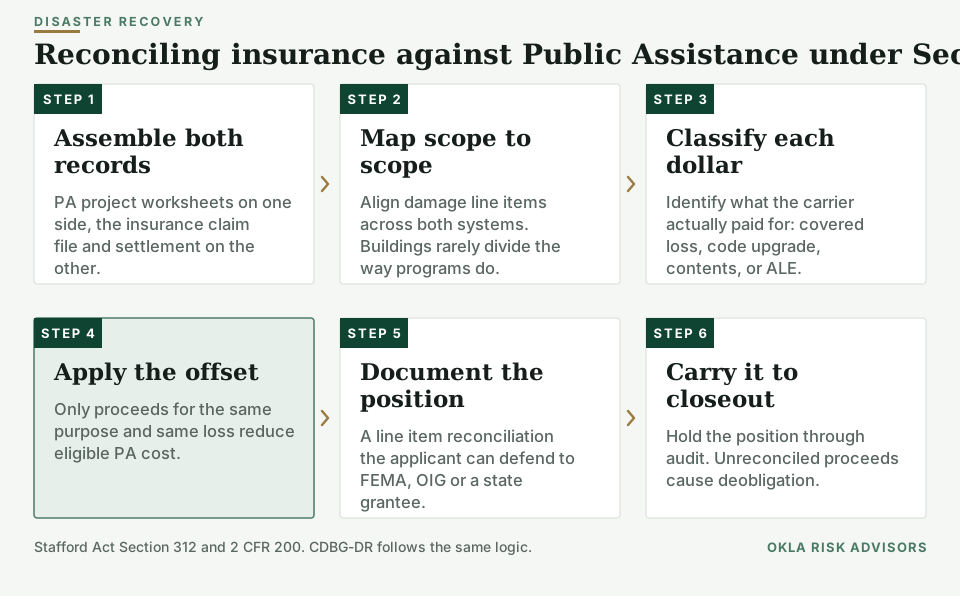
A reconciliation that survives audit works facility by facility and shows, for each one, the project worksheet scope and obligated amount, the corresponding insurance claim and settlement, the policy provisions that governed it including limits, sublimits, deductibles, and coinsurance, the allocation of proceeds to matching and non matching scopes, and the resulting net eligible cost.
It is built while the recovery is live, not reconstructed at closeout. And it requires someone who can read a commercial property policy and a project worksheet with equal fluency, which is a narrower skill set than either grant management or claims adjusting alone.
The same problem in CDBG-DR
Duplication of benefits is not unique to FEMA. Community Development Block Grant Disaster Recovery funds administered by the Department of Housing and Urban Development carry their own duplication analysis, and applicants moving between FEMA, Small Business Administration assistance, insurance, and CDBG-DR have to track every source against every scope. The discipline is the same, and so is the consequence for getting it wrong.
Common questions
What is a duplication of benefits?
It is federal assistance that pays for a loss already covered by another source, most often insurance. Section 312 of the Stafford Act prohibits it, so FEMA reduces grant funding by insurance proceeds that were received or that reasonably should have been available.
Does FEMA deduct insurance the applicant never actually collected?
It can. FEMA reduces eligible costs by anticipated proceeds, which means the amount the policy should have paid. An applicant who settles a claim below what the policy owed does not get the shortfall made up by the grant. That is why the insurance settlement and the grant scope have to be worked together.
What is the required minimum insurance obligation?
For insurable facilities damaged by a declared event, FEMA generally requires the applicant to obtain and maintain insurance going forward as a condition of assistance. Failing to maintain it can make the facility ineligible in a future event.
When do reconciliation errors usually surface?
At closeout and at audit, often two to five years after the event, when the file is reviewed and obligated funds are deobligated. By then the carrier file may be closed and the staff who handled it may be gone, which is why the reconciliation has to be documented while the recovery is live.
How this firm helps
This is the firm's signature discipline. Twenty five years of catastrophe and large loss adjusting sit behind the insurance side, and Public Assistance grant management sits behind the federal side. We reconcile settlements against grant scopes facility by facility and produce the documentation that holds at closeout and at audit, including on recoveries other firms ran.
Contact Okla Risk Advisors or email chrischambers@oklariskadvisors.com.
Related guides and services
Have a question about your own situation?
Send the specifics. You will get a straight answer about whether this is something the firm can help with.