Tribal Mitigation Plan Requirements Under 44 CFR 201.7
What a federally recognized tribe has to have on file to receive FEMA Hazard Mitigation Assistance funding, what the five year clock means in practice, and what FEMA reviewers actually look for.
What 44 CFR 201.7 requires
Title 44 of the Code of Federal Regulations, Part 201, sets out the mitigation planning requirements that govern federal hazard mitigation assistance. Section 201.7 is the part written specifically for federally recognized Indian tribal governments.
The core requirement is straightforward. A tribe that wants to receive Hazard Mitigation Assistance grant funds as a recipient, and that wants access to certain categories of non emergency assistance under the Stafford Act, must have a Tribal Mitigation Plan that FEMA has reviewed and approved. No approved plan, no recipient status.
The regulation also recognizes tribal sovereignty in a way the local government provisions do not. A tribe may apply directly to FEMA as a recipient on a government to government basis, or it may choose to participate as a subrecipient under a state. That choice carries consequences for the plan, for the administrative burden, and for who controls the priorities.
The five year clock
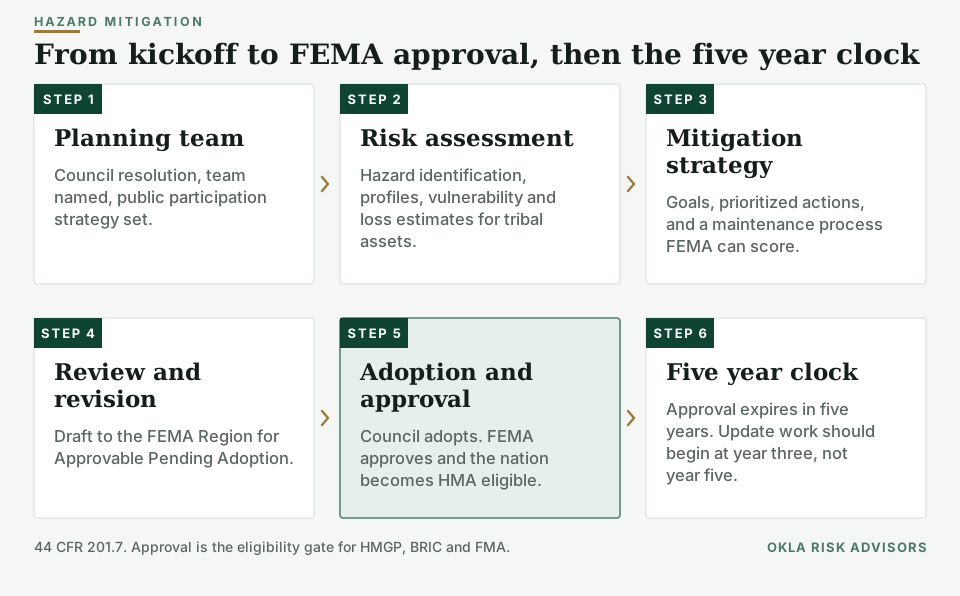
Approval lasts five years. On the expiration date the plan stops satisfying the requirement, and the nation is no longer eligible to receive Hazard Mitigation Assistance funds as a recipient until an updated plan is approved.
This is where most nations get caught. Hazard Mitigation Grant Program funding becomes available after a major disaster declaration, which is exactly the moment nobody has capacity to run a twelve month planning process. The plan has to already be current when the event happens.
A realistic schedule works backward from the expiration date:
| Months before expiration | What should be happening |
|---|---|
| 12 to 15 | Decide on the update, secure funding or a planning subapplication, procure support if needed |
| 9 to 12 | Planning team convened, kickoff held, data request issued |
| 6 to 9 | Risk assessment refreshed, action status documented, public involvement underway |
| 3 to 6 | Draft to the FEMA regional office for review |
| 0 to 3 | Revisions addressed, tribal council adoption, approval issued |
The five elements FEMA scores
FEMA regional reviewers work from the Tribal Mitigation Plan Review Guide, which breaks the plan into scoreable elements.
Planning process. Who participated, how the public and neighboring jurisdictions were given an opportunity to comment, what existing plans and studies were incorporated, and how the process will be repeated. Documentation of the process matters as much as the process itself.
Risk assessment. Hazard identification, hazard profiles including location, extent, previous occurrences and probability, and a vulnerability analysis covering critical facilities, tribal buildings, housing, utilities, enterprises, and cultural and historic resources. Loss estimation where data supports it.
Mitigation strategy. Goals, a capability assessment describing what the nation can already do, and a prioritized list of mitigation actions with a lead department, a funding path, a rough cost, and a timeline attached to each one.
Plan maintenance. How the plan will be monitored, evaluated, and updated, how it will be integrated with other tribal plans and codes, and how the public will stay involved.
Adoption. A resolution of the tribal council adopting the plan. FEMA issues approvable pending adoption when the substance is acceptable but the resolution has not been passed yet.
Paying for the plan
Mitigation planning is an eligible activity under FEMA Hazard Mitigation Assistance. Planning subapplications under the Hazard Mitigation Grant Program and under Building Resilient Infrastructure and Communities are how many nations fund plan development and updates rather than paying from general funds.
That means the practical first question is often not what does a plan cost, but which open funding cycle can carry the planning subapplication and what the application deadline is.
Where plans fail review
The recurring problems are predictable. A risk assessment that lists hazards without profiling them. A vulnerability section that never names a specific facility. A mitigation action list with no lead, no cost, and no funding source, which makes it useless as a project pipeline. An update that reprints the prior plan without documenting what changed or what happened to the previous actions. And a plan that was written by a consultant with no tribal department involvement, which reviewers can usually spot in the first ten pages.
Common questions
How long is a tribal mitigation plan valid?
Five years from the date of FEMA approval. The nation must adopt and secure approval of an updated plan before that date to stay eligible as a recipient of Hazard Mitigation Assistance funding.
Can a tribe be covered by a county or state plan instead?
A tribe may participate in a multi jurisdictional plan, but doing so generally limits the nation to subapplicant status and ties its eligibility to another government's plan cycle and priorities. Nations that intend to apply to FEMA directly maintain their own plan.
What does FEMA actually review the plan against?
The elements in the Tribal Mitigation Plan Review Guide: the planning process, the risk assessment, the mitigation strategy, plan maintenance procedures, and formal adoption. Reviewers work from a crosswalk, so a plan organized the way the crosswalk reads gets through review faster.
Who has to be at the table?
At a minimum emergency management, but a plan that survives review usually includes public works, housing, environmental and natural resources, cultural and historic preservation, health, finance, and the tribal enterprises. Neighboring jurisdictions and the state hazard mitigation officer should be given the chance to comment.
How this firm helps
We write new Tribal Mitigation Plans, bring expired plans current, and build the risk assessment and mitigation strategy that the next grant subapplication draws from. If you are not certain where your plan stands, send the nation's name and we will check the FEMA approval and expiration dates at no cost.
Contact Okla Risk Advisors or email chrischambers@oklariskadvisors.com.
Related guides and services
Have a question about your own situation?
Send the specifics. You will get a straight answer about whether this is something the firm can help with.